No published reportSelected presentation
No published report
No published report for this presentation.
Check document status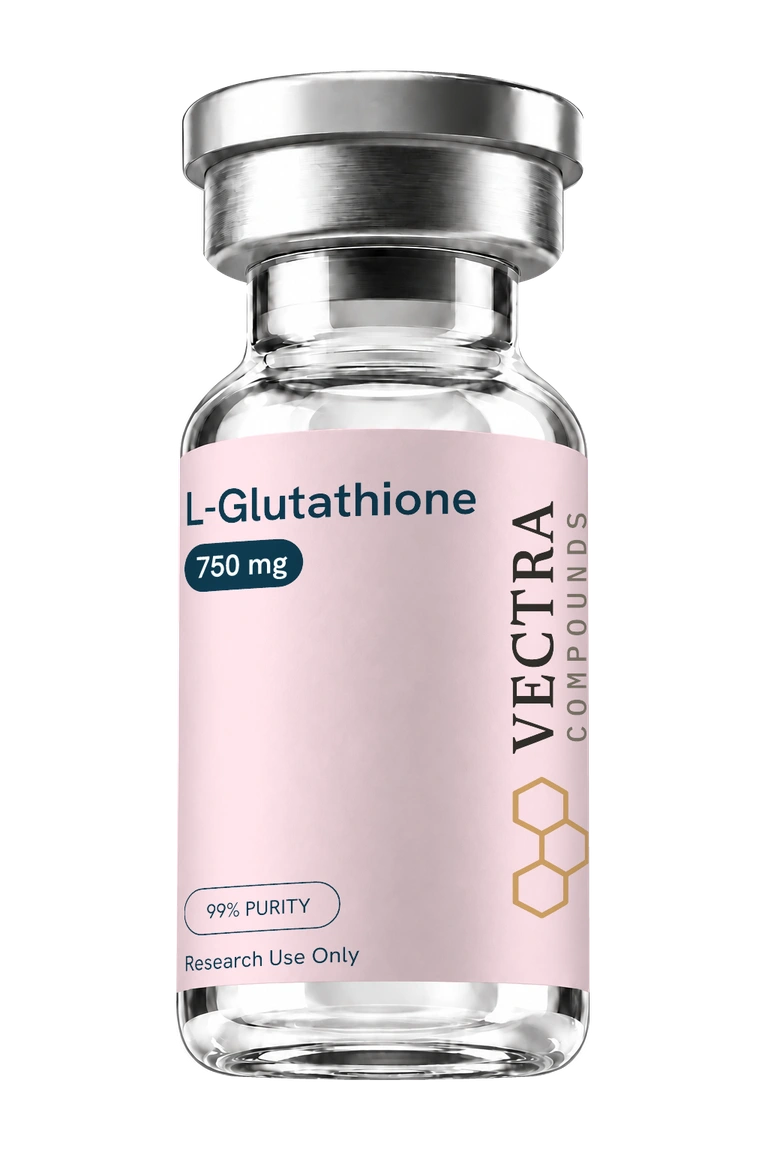
Size750MG
Quantity pricing
Buying several compounds?



No published report for this presentation.
No published report is available for this presentation.
Browse the COA library Print specification sheetNo published report for this presentation.
Check document status| Analysis | Result | Status |
|---|---|---|
| Analytical results | Not available | No published report |
No published report is available for this presentation.
Glutathione peptide reference material for in-vitro laboratory research and analytical method development. Research use only. Not for human or veterinary use; no therapeutic, preventive, or diagnostic claims are made or implied.
Explore published literature Search PubMed for L-GlutathioneRefer to the product label and lot-specific documentation for storage and handling instructions.
L-Glutathione supplied in the selected 750MG presentation. Other supplies are listed separately unless explicitly included in an offer.
No published report is available for this presentation. Contact Vectra with the product code and any printed lot for documentation assistance.
L-Glutathione is a endogenous non-enzymatic tripeptide antioxidant of 3 amino acids. Sequence: Glutamate-Cysteine-Glycine (ECG). Synthesised endogenously in mammalian cells, principally in the liver.
Scavenges reactive species, acts as a cofactor for glutathione peroxidases and S-transferases, regulates redox-sensitive transcription factors, and is reported to protect against ferroptosis. We make no claim as to mechanism or effect.
A well-characterised endogenous molecule. Human trials on record include Richie et al. (2015) on body stores and Kumar et al. (2023) on GlyNAC, alongside dermatological studies.
Studied in oxidative stress, redox signalling, ferroptosis, and dermatological applications. We supply it as a reference material for in-vitro laboratory research and analytical method development only.
Rated 3 of 5 for oxidative stress biomarkers and skin lightening, and for GlyNAC ageing hallmarks. 2 of 5 or lower for NAFLD and Parkinson's disease. Indication-dependent, and the better-evidenced results are biomarker endpoints rather than clinical outcomes.
Oral safety is favourable, with bloating and nausea reported. Intravenous administration is a different risk profile entirely: anaphylaxis, Stevens-Johnson syndrome and acute kidney injury are associated with it, and IV forms have drawn FDA safety warnings.
Stability is formulation-dependent: oral S-acetyl-glutathione is reported stable, while liposomal formulations typically require refrigeration.
Our sources carry no CAS number, molecular formula, or molecular weight for Glutathione.
Direct glutathione has no FDA-approved therapeutic indication. Intravenous forms have been the subject of FDA safety warnings. No therapeutic, preventive, or diagnostic claims are made or implied.
Yes — in more than one way:
These are the specific, documented failure modes that lot-level third-party analysis addresses. A report reachable from the lot code printed on the vial — without asking the seller for it — is the only document that answers 'is this vial what the label says'. That is why every Vectra vial carries a QR code resolving to its own lot's published report.
Findings reported by commercial testing providers. Each names its source; none is registry- or peer-review-grade, so read them as a documented pattern rather than established prevalence.
Yes, and altered certificates have been reported in this market at material rates — see the testing findings above. Three properties make a report hard to fake:
Peptide identity data in the vendor market is often wrong in ways that are hard to see. Near-identical compounds get their CAS numbers, residue ranges, formulas and molecular weights swapped. A certificate can be internally consistent and still describe a different molecule than the label names. Most commercial peptide material ships as an acetate salt, not free base. The two forms have different measured masses, so a figure quoted against the wrong one will not reconcile. A report that does not state which form it assayed cannot be checked at all.
The standard our own reports are built to meet:
FDA has acted in this market between 2024 and 2026. Actions include a civil forfeiture over $1.7 million against a compounding operation, several rounds of warning letters to peptide vendors, and more than thirty letters in March 2026 concerning compounded GLP-1 products.
Buyers here increasingly compare document trail, not price.
Explore the published literature on L-Glutathione. Start with the original papers, study methods and reported limitations.
Publications describe research on the molecule. They do not verify the identity, purity or performance of a Vectra product lot. Consult available product documentation for reported testing results.
No published report is available for this presentation.
These products are intended for laboratory research. Not for human or veterinary use.
Size750MG
Quantity pricing
Buying several compounds?
No published report for this presentation.
No published report is available for this presentation.
Browse the COA library Print specification sheetNo published report for this presentation.
Check document status| Analysis | Result | Status |
|---|---|---|
| Analytical results | Not available | No published report |
No published report is available for this presentation.
Glutathione peptide reference material for in-vitro laboratory research and analytical method development. Research use only. Not for human or veterinary use; no therapeutic, preventive, or diagnostic claims are made or implied.
Explore published literature Search PubMed for L-GlutathioneRefer to the product label and lot-specific documentation for storage and handling instructions.
L-Glutathione supplied in the selected 750MG presentation. Other supplies are listed separately unless explicitly included in an offer.
No published report is available for this presentation. Contact Vectra with the product code and any printed lot for documentation assistance.
L-Glutathione is a endogenous non-enzymatic tripeptide antioxidant of 3 amino acids. Sequence: Glutamate-Cysteine-Glycine (ECG). Synthesised endogenously in mammalian cells, principally in the liver.
Scavenges reactive species, acts as a cofactor for glutathione peroxidases and S-transferases, regulates redox-sensitive transcription factors, and is reported to protect against ferroptosis. We make no claim as to mechanism or effect.
A well-characterised endogenous molecule. Human trials on record include Richie et al. (2015) on body stores and Kumar et al. (2023) on GlyNAC, alongside dermatological studies.
Studied in oxidative stress, redox signalling, ferroptosis, and dermatological applications. We supply it as a reference material for in-vitro laboratory research and analytical method development only.
Rated 3 of 5 for oxidative stress biomarkers and skin lightening, and for GlyNAC ageing hallmarks. 2 of 5 or lower for NAFLD and Parkinson's disease. Indication-dependent, and the better-evidenced results are biomarker endpoints rather than clinical outcomes.
Oral safety is favourable, with bloating and nausea reported. Intravenous administration is a different risk profile entirely: anaphylaxis, Stevens-Johnson syndrome and acute kidney injury are associated with it, and IV forms have drawn FDA safety warnings.
Stability is formulation-dependent: oral S-acetyl-glutathione is reported stable, while liposomal formulations typically require refrigeration.
Our sources carry no CAS number, molecular formula, or molecular weight for Glutathione.
Direct glutathione has no FDA-approved therapeutic indication. Intravenous forms have been the subject of FDA safety warnings. No therapeutic, preventive, or diagnostic claims are made or implied.
Yes — in more than one way:
These are the specific, documented failure modes that lot-level third-party analysis addresses. A report reachable from the lot code printed on the vial — without asking the seller for it — is the only document that answers 'is this vial what the label says'. That is why every Vectra vial carries a QR code resolving to its own lot's published report.
Findings reported by commercial testing providers. Each names its source; none is registry- or peer-review-grade, so read them as a documented pattern rather than established prevalence.
Yes, and altered certificates have been reported in this market at material rates — see the testing findings above. Three properties make a report hard to fake:
Peptide identity data in the vendor market is often wrong in ways that are hard to see. Near-identical compounds get their CAS numbers, residue ranges, formulas and molecular weights swapped. A certificate can be internally consistent and still describe a different molecule than the label names. Most commercial peptide material ships as an acetate salt, not free base. The two forms have different measured masses, so a figure quoted against the wrong one will not reconcile. A report that does not state which form it assayed cannot be checked at all.
The standard our own reports are built to meet:
FDA has acted in this market between 2024 and 2026. Actions include a civil forfeiture over $1.7 million against a compounding operation, several rounds of warning letters to peptide vendors, and more than thirty letters in March 2026 concerning compounded GLP-1 products.
Buyers here increasingly compare document trail, not price.
Explore the published literature on L-Glutathione. Start with the original papers, study methods and reported limitations.
Publications describe research on the molecule. They do not verify the identity, purity or performance of a Vectra product lot. Consult available product documentation for reported testing results.
No published report is available for this presentation.
These products are intended for laboratory research. Not for human or veterinary use.